


Are you a BJJ athlete who wants to train consistently and compete at a high level without injury? Do you train 5+ days a week? Do you have aches and pains in certain positions? I can help you prioritize appropriate training volume, level and intensity with injury prevention exercises that should be incorporated into your training load to make you unstoppable in competitions.
Common Injuries In BJJ
BJJ is a sport where all joints and surrounding soft tissues are susceptible to injury due to how submissions work. After all, “tapping” someone is taking a joint to its end range of motion in order to create pain or danger.
Ligaments, joints, muscles are only capable of so much stress before they become compromised and therefore injured. And depending on how you approach it, mobility and strength are factors that can improve or worsen your joints ability to tolerate submission stress.
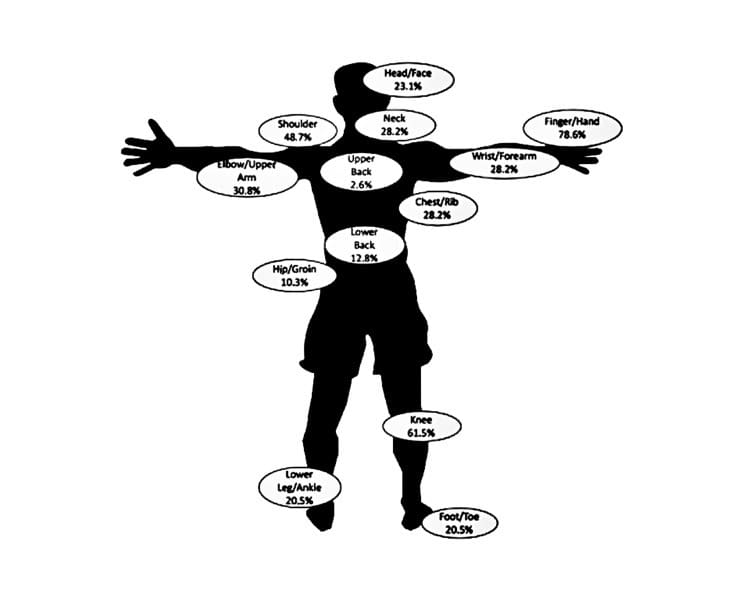
Source: National Library of Medicine (Figure 01)
Here are the rates of specific types of injuries from specific submissions:
|
Elbow (n = 14) |
4 |
MCL sprain |
Arm bar |
|
1 |
MCL sprain |
Kimura |
|
|
1 |
LCL sprain |
Arm bar |
|
|
1 |
LCL sprain |
Takedown (FOOSH) |
|
|
1 |
MCL and LCL sprain |
Arm bar |
|
|
1 |
Elbow dislocation |
Takedown (FOOSH) |
|
|
1 |
Anterior sprain (distal biceps) |
Takedown (FOOSH) |
|
|
3 |
Posterior tenderness at olecranon |
Arm bar |
|
|
1 |
Anterior sprain (distal biceps) |
Arm bar |
|
|
Knee (n = 7) |
1 |
MCL sprain |
Passing guard |
|
1 |
MCL sprain |
Takedown |
|
|
1 |
MCL sprain |
Unknown |
|
|
1 |
LCL sprain |
Direct pressure |
|
|
1 |
LCL sprain |
Varus stress with knee flexed |
|
|
1 |
LCL sprain |
Sweep |
|
|
1 |
LCL sprain (lateral meniscus tear) |
Passing guard |
|
|
Foot and ankle (n = 5) |
1 |
Ankle ATFL sprain |
Takedown |
|
1 |
Ankle ATFL sprain |
Footlock |
|
|
1 |
Turf toe |
Pushing forward |
|
|
1 |
Turf toe |
Pushing forward |
|
|
1 |
Hyperflexion sprain, great toe MTP joint |
Pushing forward |
|
|
Hand (n = 4) |
1 |
DIP sprain |
Applying arm bar |
|
1 |
Thumb sprain |
Caught in gi |
|
|
1 |
Dislocated index finger PIP joint |
Blocking opponent |
|
|
1 |
Ring finger metacarpal fracture |
Caught in gi |
|
|
Shoulder (n = 4) |
1 |
Grade I AC separation |
Kimura |
|
1 |
Anterior dislocation |
Takedown, landed on outstretched hand |
|
|
1 |
Anterior subluxation with spontaneous reduction |
Pushing opponent |
|
|
1 |
Nonspecific pain |
Unknown |
|
|
Hip (n = 1) |
1 |
Hip contusion |
Impact with opponent |
|
Cervical (n = 1) |
1 |
Cervical strain |
Triangle choke |
The Risk of Overtraining
Overtraining is a common trigger for a cascade of events that lead to injury. And what’s usually more frustrating is the realization that many injuries can be prevented with good load and volume management.
Of course, there are specific injuries (sprains, tears, strains) that can occur while you’re rolling. Largely, that’s the nature of practicing a martial art.
At its core BJJ is a full body exercise that requires significant strength, mobility, muscular and cardiovascular endurance. So, if you fatigue yourself by training too much, you don’t have a strength deficit in terms of capacity; you have a strength deficit in terms of available capacity.
This decreases your body’s ability to protect itself when training hard, which can lead to injury.
How to Manage Your Training Variables
First off, start slow. Even if there’s pressure, it’s not a race.
Generally, it’s not a good idea to jump into BJJ or any new movement pattern (especially a full body one with an intense nervous system response) with high volume and intensity.
Ease into it.
Focusing on foundations first (which may mean limiting how much you train early on) allows your nervous system, cardiovascular system, and musculoskeletal system to slowly adapt to the training volume (in PT we call this a stimulus).
Muscular strength is one component of sustainable BJJ training. Another (oft less talked about) is muscular and cardiovascular endurance. You need great stamina to endure 5+ days of rolling and training. Most people simply don’t have that reservoir of energy on day 1 without prior MMA or martial arts training.
As you’re training, pay attention to your body. If you find yourself feeling tired, fatigued, or sore don’t automatically commit to training 100% that day. If you’re operating from a reduced capacity, it’s ok (even wise) to dial it back 50% for a session or a recovery block. Do what feels right for your body.
That may mean rolling is more of a flow than an all-out effort. Listening to your body before and after sessions might mean noticing:
- Something feels tight (stretch it)
- Something feels tired or sore (rest it)
- You feel spent (it’s ok to take a day off)
Mental fatigue also plays into your training volume, too. As you’re rolling you’re constantly looking for where to defend and attack, building your intuition, reflexes, all while learning a physically demanding skill.
Develop Your Mobility
Have you noticed any limitations in your ankle mobility? How about shoulder mobility or hip mobility?
Mobility issues can stem from either tight muscles or tight joint capsule. Tight muscles need to be stretched, tight joint capsule might need a more dynamic stretch and or deeper stretch to reach the capsule. Implementing a thick mobilization band can help you perform a mobilization with movement. This will help mobilize the joint capsule and surrounding muscles.
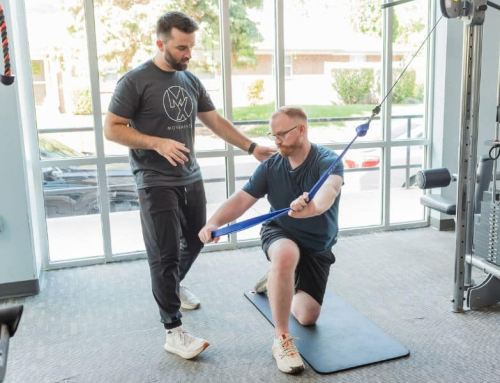
For example the half knee hip flexor stretch can be performed with a band placed as high as you can put it on your thigh that has the knee on the ground. The band should be taut and you should feel it tugging you back.
As you rock forward keeping your upright posture as you normally would for a half knee hip flexor stretch the band helps provide a hip joint mobilization as you move providing a deeper stretch. Aside from a mobilization band, a quick contract/relax technique is another way you can improve your mobility.
With contract/relax technique, you stretch a muscle right before its end range and then perform a sub-maximal isometric contraction of the muscle or even the opposing muscle just for a few seconds. You then will be able to move further into the stretch.
Mobility restrictions are important to address. If not addressed, they will increase stress placed on muscles, tendons, ligaments and joint capsules.
Build Your Stability
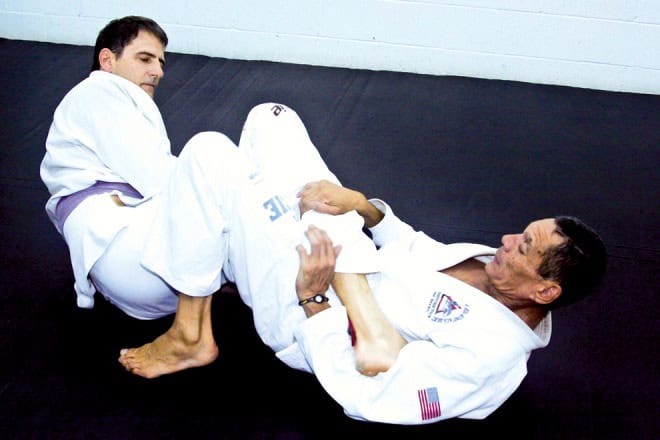
Your ligaments and muscles provide stability to your joints. Recall that putting your opponent’s joint(s) into compromised or stressed positions is a large part of what it means to submit someone in BJJ.
Bad news first: We can’t strengthen ligaments.
The good news is we can grow the muscles around them.
Generally, the stronger the muscles around your joints, the more stability that joint has in a given moment and, therefore, that joint can tolerate more stress.
Aside from the immediate area around the joint, weakness elsewhere in your body can also lead to systemic stress. For example, shoulder weakness can put more strain on your elbow. Full body progressive loading is essential for injury prevention.
However, this also loops into training volume. Strength training 5 times a week plus 4 sessions of BJJ may be too much for your body and put you at risk for injury.
A better place to start is 3 to 4 strength training sessions per week coupled with 2 to 3 BJJ sessions.
If volume in one goes up, the other should go down and vice versa.
Source: National Library of Medicine (Figure 02)
Ultimately, the nature of BJJ is to submit your opponent, who is constantly looking to put your joints in stressed positions. No amount of training management will change that fact.
However, working with your rolling partners, coaches, and physical therapist to monitor and modify your volume, mobility, and strength can make you harder to submit, all while lowering your risk of preventable injury.
If you’re practicing or competing, always tap early. Keep up with your training management, and eventually you’ll likely find you’re tapping less often.
References
- https://pmc.ncbi.nlm.nih.gov/articles/PMC5294948/
- https://pmc.ncbi.nlm.nih.gov/articles/PMC11193589/
- https://pubmed.ncbi.nlm.nih.gov/30131332/
- https://journals.lww.com/nsca-scj/fulltext/2012/04000/strength_and_conditioning_for_brazilian_jiu_jitsu.11.aspx?__cf_chl_f_tk=B40LsUVQ56SAeMatYj0J1fj4tgHQV6kY.7I2YtwogMU-1782856300-1.0.1.1-gnkH5Znd_XllOoD8HaxL5POggDbglc8dxTB9fm7bEXk
- https://pmc.ncbi.nlm.nih.gov/articles/PMC4555620/ (Figure 02)
- https://pmc.ncbi.nlm.nih.gov/articles/PMC10181877/ (Figure 01)
About the Author

Dr. Brianna Wynn is a physical therapist and Certified Strength and Conditioning Specialist treating patients in Alexandria, Virginia, and Bethesda, Maryland. She specializes in high-level sports rehabilitation, expertly bridging the gap between physical therapy and performance training for combat sports athletes, runners, rock climbers, and weightlifters. As a former collegiate sprinter and current Brazilian Jiu-Jitsu practitioner, Dr. Wynn understands the physical and mental demands of athletic training and competition firsthand.
Share This Page
Related Resources
Found this page interesting? Discover more insightful resources below.