


I have found the sweet spot! Having played badminton as a backyard Summer pastime, to tennis through high school and college intramurals I was introduced to pickleball a few years ago, and love it! With the power of tennis and the finesse of badminton it’s the perfect game-set-match!
Pickleball was first invented in the mid-1960s and has seen rapid growth in recent years and has gained popularity as one of the fastest growing recreational sports in America (1). With that increase in participation has come an increase in injuries seen by physical therapists, particularly shoulder injuries as with other racquet sports such as tennis and badminton.
Commonly experienced in players 40 and above, injuries may be experienced even sooner in more competitive or frequent players. What starts off as an intermittent pain which may be sharp or stabbing in nature then becomes a constant pain.
Usually we hope that it will just go away on its own. But then it goes from not only affecting overhead shots and reach shots but daily activities also, and even sleep!
Let’s take a look at the common symptoms, causes, and treatments to get you back on the court playing your best game, smashing the ball, volleying, and hitting point-winning powerful line shots!
Pickleball Shoulder’s Common Symptoms
There are a number of instances during the game that the shoulder pain may poke its ugly head, usually when:
- Serving or smashing the ball
- Following through or doing backhands
- Reaching down to pick up the pickleball
These shoulder pains often develop from:
- Repetitive overhead shots
- Poor serving mechanics
- Fast volleys or quick repetitive swings
- A recent increase in match play without rest
- Cumulative wear and tear over years
- Falls on the hard court
And some additional signs and symptoms I see in my practice are:
- Weakness in the shoulder
- Sharp or aching pain lifting the arm overhead
- Pain at night making it uncomfortable to lay on your side
- Pain that wakes you up in the night
- Clicking, catching, popping, or grinding sensations
- Pain reaching into cabinets or putting on clothes such as a shirt
- Morning stiffness or stiffness after playing
- Reduced or loss of movement of the shoulder
- Pain, numbness or aching traveling down the arm
The Mechanism of Pickleball Shoulder
The common theme in this condition is that some soft tissue becomes pinched between the ball and socket of the shoulder. Just as if you were to accidentally bite the inside of your cheek, it hurts, swells, and then before you know it you’re catching and re-biting it constantly because it’s in the way.
There are ranges of shoulder motion that can cause this, either mid-range which can also be known as a painful arch, or at the the extreme end of the reach, known as end-range pain or impingement.
As with most orthopedic problems, multiple issues can combine into what feels like one injury or problem. Regardless, it’s the pinching of the tissue that results in a cascade of events leading to a vicious cycle which needs to be identified, broken, and reversed so your body can start to heal.
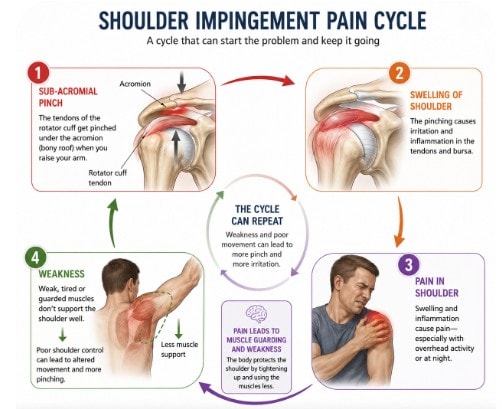
Your body was designed to repair itself from trauma and damage. Just think of your body’s response to a broken bone, cut, or laceration. The reparative process starts with inflammation, which is the culprit for some of the pain, popping and cracking. Unfortunately, without knowledge or help many people fail to get out of this stage and the pain persists.
There are a number of contributing factors of shoulder pain that may put you at higher risk of experiencing “pickleball shoulder” which include rotator cuff tendinitis or tear, joint osteoarthritis (OA), frozen shoulder (adhesive capsulitis), biceps tendinitis, or players may sustain some of these injuries from pickleball participation (2).
The important thing (and what I help patients with in my practice) is understanding which part of the pain cycle you’re in, what interventions (movements, recoveries, mobilizations) fit the problem you’re dealing with, and applying them at a pace that meets your body where it’s at.
Pickleball Shoulder’s 2 Types of Impingement
There are two types of impingement that occur between the ball and socket, which accounts for the majority of shoulder pain cases: Primary impingement and secondary impingement (3).
Understanding which type of impingement you have is vital in getting the right treatment for your shoulder. Once the correct mechanism has been established then the right course of conservative care and treatment may begin.
So what treatments should you consider for your shoulder? Depending on your unique circumstances, it could be one or more of the following:
Strengthening the Rotator Cuff
Making the rotator cuff more capable by increasing its capacity, focussing on:
- External rotation exercises
- Scapular stabilizer stability and control
Improving Flexibility
Daily mobility work across the entire shoulder girdle, especially around::
- Cross-body stretches
- Doorway chest stretches
- Thoracic spine mobility
Technique Modifications
Addressing how you’re moving while playing pickleball, for instance trying to:
- Reduce excessive overhead smashes
- Use body rotation instead of all-arm power
- Shorten backswing on volleys
Equipment Adjustments
Evaluating and modifying the gear that surrounds your playing, such as:
- Lighter paddle
- Smaller grip size if over-gripping
- Shock-absorbing paddle technology
Smart Recovery
Sharpening up often overlooked areas such as how you decide to:
- Warm up before every match
- Avoid playing through sharp pain
- Schedule recovery days

There’s a plethora of information on the web, but what treatment is right for your shoulder?
Most pickleball-related shoulder injuries improve with prompt, personalized care, helping players of any age recover faster, move with confidence, and stay on the court longer.
As a player myself, I love working with and helping pickleball players of all ages and all skill levels. I and other MovementX providers can meet you on the court, at your home, or whenever and wherever else fits into your life to get you started on a personalized plan built around your specific needs, goals, and timelines.
Have questions? Looking for where to start? Reach out to me and I can help connect you with the right people and resources to get you back on the court playing your best.
References
- Massillon, D., Anders, A. & Vitale, K. Diagnosis and Management of Common Musculoskeletal Injuries in the Pickleball Athlete. Curr Phys Med Rehabil Rep 13, 27 (2025)
- Meng Y, Chen A, Nguyen C, Kaufman M, Li D, Pham N, Chou R, Roh E. Pickleball-related injuries treated at a tertiary academic center over five years: a cross-sectional study. Inj Epidemiol. 2026 Apr 14;13(1):39
About the Author

Andy Smith, PT, MHS is a physical therapist based in Carmel, Indiana, serving the North Indianapolis suburbs. With over 20 years of clinical practice, he specializes in orthopedic rehabilitation, post-concussion management, vestibular therapy, and the treatment of all spine conditions. Andy is a certified practitioner in the McKenzie Method (MDT), allowing him to provide highly specialized, evidence-based care tailored to each patient’s unique needs. Known for his compassionate attitude and astute listening skills, his mission is to empower his patients to overcome injury, move well, and live their healthiest, most active lives.
Share This Page
Related Resources
Found this page interesting? Discover more insightful resources below.