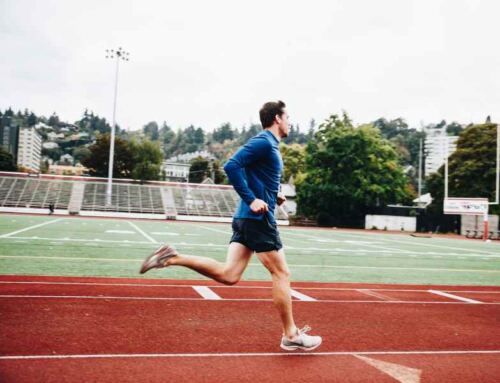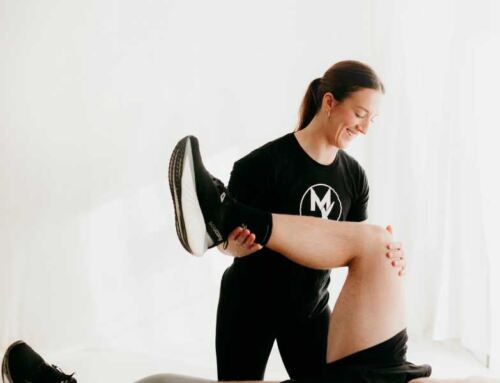



Chloe started running because all of her friends were doing it. She even signed up for her first half marathon. About two months before race day she began to notice pain on the front of her knee.
At first it was only during her runs and she was able to push through (framing it as “toughness”).
But then it was there for a day after she finished the run. Then two.
Then when she would go down the stairs or when she would squat to get something from the floor. Worried that she wouldn’t be able to run her big race, Chloe reached out to a physical therapist for advice.
Chloe’s a persona of a type of runner who often shows up on my table or in my treatment sessions. If any of Chloe’s story resonates with you, here’s some info that might help.
Runners & Knee Pain
Pain that’s felt on the front of the knee around or behind the kneecap is informally called “runner’s knee” and formally known in the PT world as anterior knee pain.
5.4% of all sport injuries (not just running) are due to anterior knee pain with long distance runners as the group that’s most at risk within the running community, and higher rates (sometimes called prevalence) in female athletes.
Chloe’s situation is surprisingly common. Up to 70% of runners will experience some type of injury during a training year with 80% of those injuries being at the knee or below.
Causes of anterior knee pain usually include:
- Overuse/overtraining
- Muscular weakness
- Poor joint alignment
- Improper shoes
When I took a look at what Chloe was bringing to the road on every run a couple of things popped out (pun intended).
In our eval session, I notice she has increased movement of her knee cap side to side, weakness with hip strength testing and difficulty controlling her knee when performing a single-leg squat (which I can use to reliably recreate the pain she feels).
Running Gait Analysis
To look at Chloe’s running gait, I perform a running gait analysis after one of her distance workouts to see exactly what her legs are doing with each step.
Now, there are two types of gait analysis commonly used, two-dimensional gait analysis (2D) and three-dimensional gait analysis (3D).
2D gait analysis involves taking a video of the person running from the front, back and side and breaking down the angles for each step.
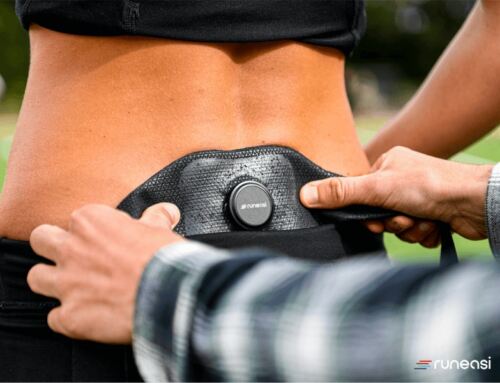
3D gait analysis uses a camera behind the treadmill to identify over 60 different data points in the run.
More data generally means more ways to spot patterns.
By using a 3D gait analysis we know within seconds whether you’re a forefoot striker versus heelstriker, if you land too far in front of your body or if your knees are collapsing.
In Chloe’s case, the gait analysis shows that when Chloe’s foot hits the ground her knee caves inward and her opposite hip drops, creating a lopsided pelvis position. As part of our session, I teach Chloe that this is formally called a collapsing knee with contralateral pelvic drop. I also share with her the research: for every 1 degree of the hip dipping, her risk of injury increases to 80%.
Gait Retraining
Now that we know the pattern, Chloe and I can work to modify it. With what the gait analysis showed, I target a few things directly within our sessions.
Glute Activation
The first exercise I have Chloe learn and progress is glute isometrics, resisted holds to ensure her glutes are activating.
Pelvic Stabilization
Then we progress to a single leg squat at the wall with the opposite leg pushing a ball on the wall to focus on keeping her pelvis level.
Hip Strength
I add heavier hip strength exercises including a single leg bridge, weighted lateral lunges through a controlled range, and single weighted squats.
Strength training can help to improve gait, but sometimes our brains have become so used to doing something a certain way that we need specific cues to change, with a lot of practice.
Motor Patterns (Breaking Old Habits)
To work on retraining Chloe’s brain and motor patterns we do single leg squats with focus on driving her knee over her second toe, without slipping inwards.
We do a wall drill, leaning from the ankle and driving the knee straight forward.
Finally when on the treadmill, I give her the cue to drive her knee forward with each step, like her knee caps are headlights.
Note: The above is an example of how working directly with me or another MovementX physical therapist can give you a specific training protocol based on your actual movement patterns. It is not medical advice.
Race Day
By race day Chloe’s pain decreases enough for her to complete the race with her friends. More importantly, she feels confident in her stride again.
She continues with her exercise program on her own, reaches out to me occasionally with questions, and no longer experiences pain with squatting or doing stairs.
Then she PRs. Then again. And again.
Most runners will experience knee pain at some point in their running journey, and it doesn’t have to be the end of the road.
Finding a qualified physical therapist who specializes in runners (like me) can help identify where your system is breaking down and how to put it back together. Reach out if you want to chat about how I can help.
References
- Martinez-Cano JP, Ramos-Rivera JC, Gómez-García J, Casas–Barragán GA, Rosales MC, Escobar-Gonzalez SS. Anterior knee pain in runners after a half-marathon race. Journal of Clinical Orthopaedics and Trauma. 2021;23:101640. doi:https://doi.org/10.1016/j.jcot.2021.101640
- Smith BE, Selfe J, Thacker D, et al. Incidence and Prevalence of Patellofemoral pain: a Systematic Review and meta-analysis. Screen HR, ed. PLoS One. 2018;13(1):e0190892. doi:https://doi.org/10.1371/journal.pone.0190892
- Ferber R, Hreljac A, Kendall KD. Suspected Mechanisms in the Cause of Overuse Running Injuries: A Clinical Review. Sports Health: A Multidisciplinary Approach. 2009;1(3):242-246. doi:https://doi.org/10.1177/1941738109334272
- Bramah C, Preece SJ, Gill N, Herrington L. Is There a Pathological Gait Associated With Common Soft Tissue Running Injuries? The American Journal of Sports Medicine. 2018;46(12):3023-3031. doi:https://doi.org/10.1177/0363546518793657
About the Author

Dr. Becky Ocel is a physical therapist based in Pittsburgh, Pennsylvania. Drawing from her own background as a soccer player and kickboxer, she specializes in sports injury recovery, advanced running gait analysis, and orthopedic rehabilitation for runners, gymnasts, martial artists, and active adults. Dr. Becky goes beyond simply treating pain to actively build strength, improve movement mechanics, and reduce the risk of future injuries so you can feel empowered and confident when doing the activities you enjoy.
Share This Page
Related Resources
Found this page interesting? Discover more insightful resources below.