


Part 1 of a 2-part series on MovementX’s approach to clinician retention.
Early in my career as a physical therapist, I spent a lot of time trying to determine what I wanted to do and where I wanted to work.
I had always assumed I would build my career in outpatient orthopedics. Then I completed an inpatient neuro rehabilitation rotation and loved it. I considered opening a private practice, but after seeing the pressures carried by one of the practice owners I worked for, I began to question whether that was the right path for me.
Eventually, I realized I was asking the wrong question.
Instead of asking where I wanted to work or what I wanted to do, I began asking a different one:
Who do I want to be surrounded by?
The answer was clear. I wanted to be surrounded by talented, dedicated, passionate, and driven individuals.
That realization shaped my career and has shaped MovementX over the years.
Great Teams Are Built Over Time
I’ve always loved being part of a team and watching teams develop.
There’s something deeply moving about seeing a group of people learn how to accomplish more together than any individual could accomplish alone. Over time, people begin to understand one another’s strengths, tendencies, and rhythms. Trust deepens. Communication becomes easier. The entire group becomes more capable, and collective intelligence emerges.
This belief is embedded in the MovementX Founding Story.
Any one of our Founding Teammates (and many MovementX physical therapists today) could have started an independent practice. Instead, we chose to build something together: a community provides clinicians with the autonomy of entrepreneurship and the support, infrastructure, community, and shared mission of a larger team.
The same principle is visible in team sports.
Think about Michael Jordan and Scottie Pippen winning six championships together. Or Tim Duncan, Tony Parker, and Manu Ginóbili spending more than a decade learning how to adapt their individual roles for the good of the San Antonio Spurs, and taking home just a few championships in the process.
The best teammates don’t simply react to where someone is standing. They anticipate where that person is going. Sometimes without even being able to see them.
There’s chemistry. There’s rhythm. There’s trust. And there’s a profound sense of joy that comes from experiencing the journey together.
Organizations can develop that same kind of chemistry, but only when people have enough time together to build it.
Research supports the connection between organizational stability and performance. Meta-analyses have found that higher employee turnover is generally associated with lower organizational performance. And as Adam Grant brilliantly points out with a plethora of research, teams that stay together longer perform better (even for cardiac surgery 🤯).
In other words, retention is not merely an HR metric. It influences how effectively people communicate, solve problems, serve patients, and support one another; it impacts how effectively we pursue our mission.
That’s one of the main reasons why retention matters so much to us at MovementX.

Retention Benchmarks in Physical Therapy
We face an interesting challenge in physical therapy in regards to these metrics: No one calculates retention and turnover the same way.
And yet it’s critical to find and reference benchmarks in order to understand how we’re performing against the larger industry and healthcare in general.
Based on our research, here are the tiers we’ve established as benchmarks within the physical therapy industry:
The industry norm sits around 20% to 30% (or more) turnover rate according to BLS Data, SHRM surveys, and so on.
A healthier turnover rate for an above average physical therapy organization is in the 10-15% range.
At MovementX, we aim for 5% turnover (or less).
Recently, we found out Patagonia’s turnover is only 4%, so we might lower our target to match them as well. We want MovementX to be to physical therapy what Patagonia is to the business world.
In fact, MovementX was created to offer a different path, just like Patagonia offered a different path in apparel.
Our model helps physical therapists build mobile physical therapy caseloads within a supportive community, nationwide. MovementX providers provide concierge physical therapy, cash-based, or out-of-network services while receiving operational support, professional development, and access to peers who are also practicing at the top of their license.
We don’t believe clinicians should have to choose between autonomy and community.
We believe they can have both.
MovementX’s Turnover Stats
For the first five years of our history at MovementX, we had 100% retention. Not a single one of our full-time physical therapists left the company. For five years.
In fact, we even had a provider move across the country and take MovementX with her, meaning she started a market in the brand new place she moved.
For years, we informally aspired to maintain zero turnover. As we grew, however, we recognized that zero is neither a realistic nor necessarily a healthy long-term target. People’s lives change. Their families move. Their professional aspirations evolve. Sometimes an individual and an organization simply move in different directions.
So now our target is 5%. Our equation to calculate turnover is simple:
Turnover Rate = (Number of Separations ÷ Average Number of Employees) × 100
We calculate it on a quarterly basis, and include all employees who have left, regardless of their position.
Without further ado, here’s our actual data as of the time of this writing:
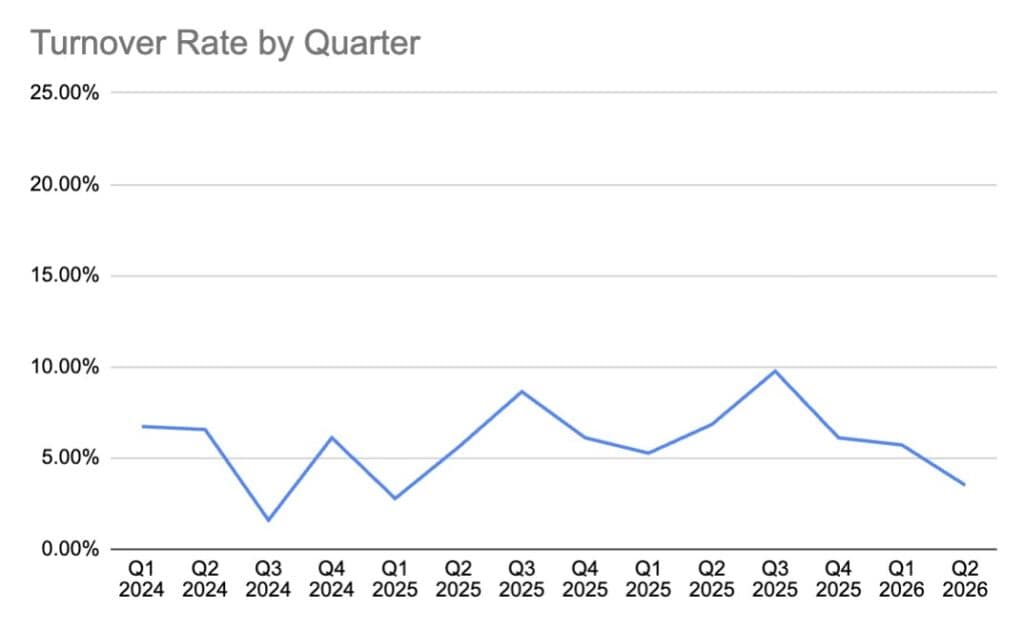
MovementX quarterly turnover rate. Lower percentages indicate stronger retention (down = good!)
We haven’t always been at our target of 5%, but we’ve hovered around it and are getting closer to consistently being there.
The objective isn’t perfection. It’s to build an organization where exceptional people can do meaningful work, grow professionally, and genuinely want to stay.
And thanks to the hard work of every MovementX team member, we’re getting better and better as time goes on.
The MovementX Retention Philosophy
In part two of this series, I’ll explore the pillars of our retention philosophy in greater detail. For now, three areas are worth highlighting.
- We champion culture above all else. We want our team to know the grass is so green, they don’t even need to look at the other side. That doesn’t mean pretending the organization is perfect. It means creating a culture in which people can speak honestly, solve problems constructively, and see that leadership is committed to making the community better.
- We have a rigorous hiring process and high standards to make an offer. Every step of the interview process is transparent, but the reality is every new individual either raises the level of the overall community or detracts from it (which is why we look at if they ‘raise the bar’ or not, and our offers only go out if they verifiably raise the bar).
- We invest in our people once they’re here. Our first 100 days are heavy on skill development. Once their foundational skills are set, we help them become more efficient, so they can have a full caseload and have extra time in the day- unheard of in most healthcare arenas. From there, we invest in their continuous growth via leadership, management, and clinical training pending their interests.
The goal isn’t simply to help someone succeed in their current position. It is to create physical therapy careers that can evolve as the person evolves.

Building Something Worth Staying For
Everyone wants to be the Chicago Bulls of the 90’s or the San Antonio Spurs of the late 90’s and 2000’s. But one critical ingredient that too often gets ignored is retention.
It takes time to learn how to play together. It takes consistency to build trust. It takes working through difficult conversations and situations to have faith in each other.
Our founding team has now been building MovementX for approximately a decade. The original inspiration remains the same: bring talented, dedicated, passionate, and driven people together, then create the conditions for them to do their best work.
Today, that community has grown to approximately 100 people.
Each new team member brings new energy, knowledge, and possibility. Each person has the opportunity to make MovementX stronger.
But the full value of that potential emerges only when people have a reason to stay.
Retention, then, is not the final objective. It’s evidence of something deeper. Evidence that people feel connected to the mission. That they’re continuing to grow. That they trust their teammates. That they can see a future for themselves here.
Our responsibility as leaders is not to persuade people to remain in an organization that is no longer serving them.
It is to keep building an organization worth choosing, again and again.
In part two, I’ll share the specific pillars that help us work toward that goal.
About the Author

Dr. Josh D’Angelo is a physical therapist in Alexandria, VA and co-founder and CEO of MovementX. As a Board Certified Specialist in Orthopedics, Josh D’Angelo is passionate about the role that a physical therapist can play in solving some of health care’s biggest challenges. His love of utilizing movement to improve health and quality of life fuels his efforts every day.
Share This Page
Related Resources
Found this page interesting? Discover more insightful resources below.