


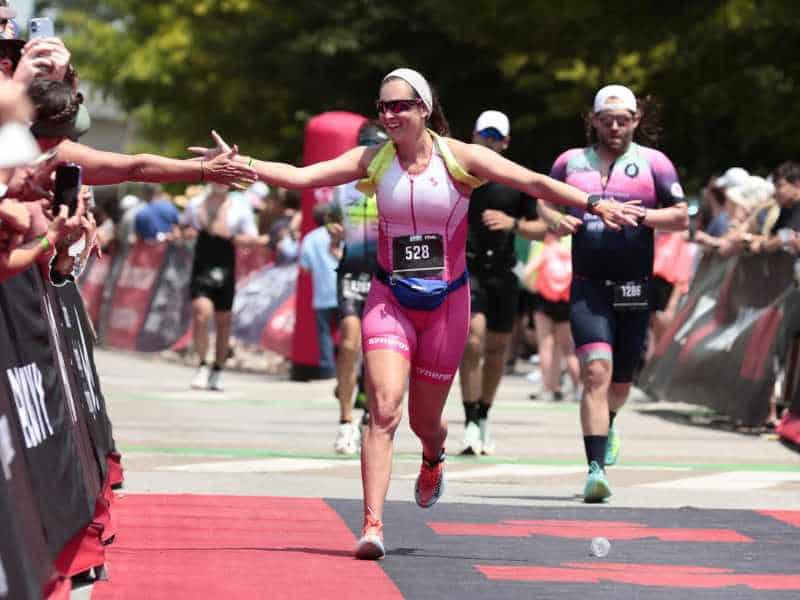
When I told people I was training for a 70.3 Ironman, I usually got one of three responses:
“That’s awesome!”
“Are you crazy?”
Or my personal favorite:
“Wait… aren’t you a physical therapist with a knee problem?”
That last one usually came with a look suggesting I should probably sit down and rethink my life choices.
And, to be fair, they weren’t wrong.
As a physical therapist, I spend my days helping people recover from pain, injury, and the occasional questionable decision they made during a weekend sport they swore they were “still fine” to play.
Before we go any further, I should make one thing clear: I am by no means an endurance coach or expert in long-distance training. I didn’t approach this as someone with years of Ironman experience or a perfectly designed training system.
What I did have was a foundation. I had completed shorter triathlons in the past, spent years as a collegiate athlete learning how to train consistently, and had the benefit of understanding exercise physiology, injury management, and recovery through my education and work as a physical therapist.
That background gave me some useful tools, but it certainly didn’t make me immune to self-doubt, fatigue, missed workouts, or the challenge of preparing for an event that was far longer than anything I’d ever attempted.
So naturally, I decided to spend four months swimming, biking, and running my way toward a 70.3 Ironman with the same knee problem I sometimes help other people rehab.
On purpose.
Somewhere between “this is a great challenge” and “this might be a terrible idea,” training began.
What surprised me most wasn’t the volume. It wasn’t the fatigue. It wasn’t even race day itself.
It was what the process taught me about adaptation, recovery, and what we’re actually capable of when circumstances aren’t ideal.
Because here’s the reality: things are almost never perfect.
There will always be an old injury, a busy work schedule, a missed workout, poor sleep, unexpected stress, or some other reason to believe you’re not ready.
Yet the human body (and mind) are remarkably adaptable.
This journey didn’t teach me how to train perfectly.
It taught me how much progress is possible when you stop waiting for perfect conditions and start working with the body you have today.
And 70.3 miles later, that may have been the most valuable lesson of all.
The Structure Behind the Chaos
My training week always started on Tuesday because Mondays were non-negotiable recovery days.
No intervals. No long workouts. No “feeling fine so I should probably do something.” Just recovery.
One thing endurance training makes very clear is that fitness doesn’t improve during training, it improves when you recover from it. The workout is just a stimulus. Adaptation happens after.
Most training followed a 3 week build, 1 week deload pattern, with volume reduced by about 20% on recovery weeks.
The structure stayed consistent. The stress didn’t.
Early on, long rides were 30-45 minutes. By peak training (about 4 to 6 weeks before race day) they were 3 to 3.5 hours.
It’s strange how quickly “a long ride” redefines itself when you’re deep in training.
Tuesday: Bike Intervals
Tuesday was interval bike day with the goal of VO2 max development and increasing time spent near threshold. Tuesdays reminded me what hard actually means.
Early intervals were around 5 minutes. Later, they stretched to 10 to 15 minutes.
My training was roughly structured as:
- 5 to 15 minutes at threshold
- 2 to 3 minutes in Zone 2 recovery
- Repeat for 30 to 45 minutes
These were not Zone 2 rides. Zone 2 builds endurance. Threshold work builds capacity and demands respect in return.
One of the biggest lessons I learned was that hard days don’t just challenge fitness… they require real recovery afterward. I can’t just stack intensity and expect adaptation to keep up.
Wednesday: Strength, Stability, and Swimming
Wednesday was strength training and swimming.
For me, strength work emphasized lower-body stability. For someone else, it might mean a cranky shoulder, a sore Achilles, or a back that’s been “off” for years.
As PTs, we spend a lot of time helping people focus on what they can do. Somewhere in this process, I had to take my own advice.
Training should fit the person, not the other way around.
Swim volume started at 1,500 to 2,000 yards and built to 2,000 to 2,500 yards consistently.
Swimming built my aerobic capacity without impact, but intensity still mattered when I pushed it.
Thursday: Run Intervals and Accumulated Fatigue
Thursday was run interval day, which followed the same idea as the bike:
- Work near threshold
- Reconsider life choices
- Recover
- Repeat
Early sessions were shorter, but by peak training I was completing:
3 × 20-minute threshold holds with 5-minute Zone 2 recovery between efforts
Those sessions weren’t easy.
Holding a threshold for 20 minutes requires pacing, discipline, and a willingness to sit right on the edge of sustainable effort. Go too hard and I fade. Go too easy and I miss the stimulus.
Those workouts didn’t just challenge fitness, they started to shape the rest of the week. There were plenty of Fridays where I could still feel Thursday in my legs.
And even on lighter days, I knew what Saturday required.
Because Saturday wasn’t just a bike ride.
It was a brick.
The Weekend Volume Monster
The weekends were where training became real.
Saturday: long Zone 2 bike + brick run
Sunday: long Zone 2 run
Early on, even the idea of this felt like a lot.
The bike alone was intimidating. I didn’t even fully know how to ride clipped in comfortably, let alone spend hours in an aerodynamic position, then run off the bike afterward. That felt like a completely separate skill set from fitness.
But like everything else, it adapted.
What once felt awkward became normal. What once felt unsustainable became routine. The bike-to-run transition eventually stopped feeling like a shock and became just part of training.
By peak training, I was riding 3 to 3.5 hours and running off the bike.
And somehow, that became manageable.
Looking back, maybe the people asking if I was crazy weren’t entirely wrong.
There were definitely moments where spending half a day exercising (and then adding more on top of it) felt questionable at best.
But something unexpected started happening in those long sessions.
Somewhere along the way, it became therapeutic.
And somewhere in that process, a simple truth started to show up over and over again:
Training didn’t get easier, I just got better at adapting to it.
The Unexpected Part
When most people hear “hours of training,” they assume there’s music, podcasts, or audiobooks filling the space.
There weren’t.
When I swam, there was nothing but water and breath. When I biked, there was just the road and the ride.
At first, that sounded unbearable. I was used to constant input. Silence feels unfamiliar.
But endurance training removed that option. And in doing so, it created something unexpected.
Space.
Space to think.
Space to process.
Space to not think at all.
Some rides were spent thinking about patients. Some runs were spent thinking about life outside of work. Other times, there was nothing except movement.
And strangely, that became one of the most valuable parts of the entire process.
The training stopped being only physical.
It became therapeutic.
A reminder that growth doesn’t always come from pushing harder. Sometimes it comes from slowing down enough to actually hear myself think.
I never thought I could spend that many hours alone with my thoughts.
But I did.
And eventually, I started to look forward to it.
What I Learned
I started this process thinking I understood endurance training. I finished it realizing I had a lot more to learn.
- I learned how powerful heart rate management is
- I learned how much nutrition affects consistency
- I learned that sleep isn’t optional if you want to adapt
Most importantly, I learned that training plans are guidelines, not rules.
Some weeks click. Some weeks don’t.
Some days I push. Some days I recover.
Knowing the difference matters more than any single workout.
Because fatigue isn’t a badge of honor, it’s information.
The Taper
The final two weeks were about reducing, not building.
Two weeks out I reduced volume by ~50%.
Race week I reduced volume by ~75%.
Tapering feels unnatural after months of building, but fitness isn’t created in the final two weeks. It’s revealed there.
My goal was simply to show up ready to use what I’d built.
More Than a Race
Looking back, maybe the people asking if I was crazy weren’t entirely wrong.
There were long rides. Long runs. Brick workouts. Fatigue that carried across days. And plenty of moments where simply showing up was enough.
As a physical therapist, I started this journey focused on the science of it all. The heart rate zones, VO2 max, recovery, strength work, and load management.
All of that mattered.
But what I didn’t expect was how much I would value the quiet.
The hours in the pool with nothing but breathing.
The long bike rides with no distraction.
The runs where the only task was to keep moving forward.
One thing I hope people take from this is that injuries don’t have to define what comes next.
That doesn’t mean ignoring them. It doesn’t mean pushing through pain. It means adapting.
As a PT, that’s what I try to help people do every day. Focus on what you can do, not what you can’t.
My knee was simply one variable in the equation. It required adjustments, but it never defined the outcome.
Most of us are carrying something.
The goal isn’t perfect conditions, it’s forward progress anyway.
And that 70.3 finish line was incredible.
But what I’ll remember most is everything that led up to it:
- The structure
- The fatigue
- The adaptation
… and the quiet moments that changed the way I think about training and life.
And for anyone still wondering, my knee survived and it’s better than ever.
Reference guide
| Term | What it means | Why it matters |
| VO₂ max | The maximum amount of oxygen your body can use during intense exercise. | Your “engine size”; higher values generally allow for better endurance performance. |
| Zone 2 training | Easy-to-moderate aerobic exercise that maximizes fat burning and builds endurance. | Improves the efficiency of your aerobic system. |
| Threshold training | Training near the highest intensity you can sustain for an extended period. | Increases the pace or power you can maintain before fatigue rapidly sets in. |
| Aerobic capacity | Your body’s overall ability to produce energy using oxygen. | Encompasses endurance and supports sustained exercise.
|
Sources
- American College of Sports Medicine ACSM’s Guidelines for Exercise Testing and Prescription; Physiology of Sport and Exercise; recent overview
- American College of Sports Medicine; Physiology of Sport and Exercise; discussion of the distinction between VO₂ max and endurance performance
About the Author

Dr. Ashton Grimm is a physical therapist and certified Orthopedic Specialist in Knoxville, Tennessee. Among Ashton’s treatment specialties are orthopedics, sports, neurologic, geriatrics, and vestibular conditions. Dr. Ashton works with a wide range of individuals, from athletes and runners to working moms, active grandparents, and young professionals, helping you stay mobile, independent and pain-free.
Share This Page
Related Resources
Found this page interesting? Discover more insightful resources below.